
What is the antenna on the mountain for?
Mountain Hiking + Amateur Radio = SOTA
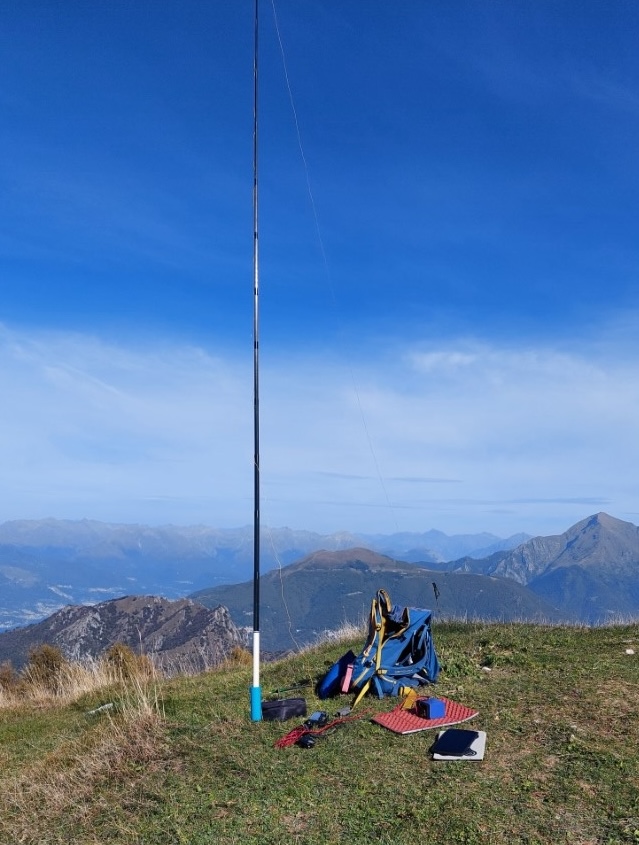
The “fishing rod” is part of an antenna. If you look closely, you can see a thin wire. We amateur radio operators use it to make connections all over the world. This is done using Morse code or voice communication on shortwave. Because the radio is powered by a rechargeable battery, the transmission power is quite low: five to ten watts is typical; that’s roughly equivalent to the power of a good bicycle light. Even with these simple means, it’s possible to reach radio partners throughout Europe. When radio conditions are good, contacts with other continents are made regularly. The whole system operates independently of the internet and cell phone carriers and works even during a power outage.
SOTA (Summits On The Air) is an outdoor variation of the hobby of amateur radio.
Amateur radio operators carry their radios, batteries, and antennas up the mountain and use them to contact friends who are either on another summit somewhere in the world or waiting for their mountain companions at their home radio stations.
Rules of the Game
- Respect for nature is a given for all participants.
- Peaks eligible for so-called “activation” must have a prominence of at least 150 meters. Radio operations must take place at the summit or no more than 25 meters below it.
- The final ascent to the summit and the transport of equipment are generally carried out using muscle power. Operations must be conducted independently of any vehicle.
- Permanently installed power sources or fossil-fuel generators are not permitted.
- The person who transmits from a summit and those who establish radio contact with him or her earn points for doing so. This is very popular among award collectors. There are no prizes, but you can compare your results with those of your peers at https://www.sotadata.org.uk.
Who invented it?
SOTA was founded in March 2002 by amateur radio operators in England and Wales. Today, there are more than 10,000 amateur radio operators worldwide who share this hobby.
Is the reception particularly good up here?
Yes, but that’s not just because of the altitude—it’s also because there’s less interference from electronic devices up here than at home. But that’s not the main reason why someone would carry their radio equipment up the mountain.
Then why go to all that trouble?
Above all, it’s about the joy of hiking or mountaineering, and about radio communication in nature. It’s also about nurturing friendships, since many “mountain radio operators” have known each other for years, even if they live thousands of kilometers apart. And finally, there’s the appeal of the challenge of making your gear as light as possible and constantly improving it.
With a little tinkering, you can get the weight down to under two kilograms. A home radio setup often weighs more than ten times that much. Many amateur radio operators who live in urban areas also can’t set up an outdoor antenna at home at all, or experience so much interference from electronic devices, power supplies, solar panels, etc., in the neighborhood that they can’t hear signals from more distant stations.
Is that allowed?
Amateur radio operators take an exam administered by the Federal Office of Communications (OFCOM) to obtain a license.
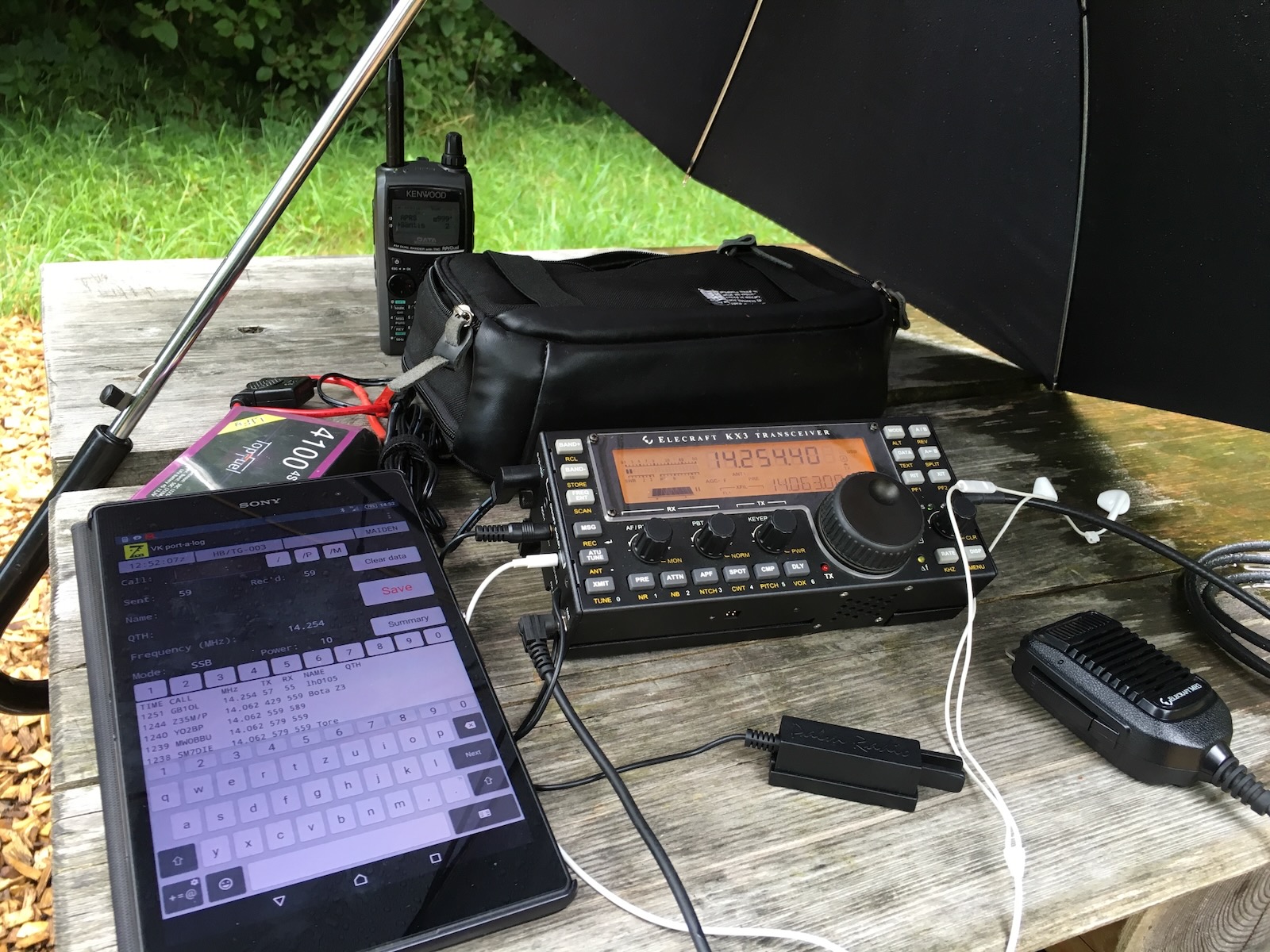
A typical portable shortwave radio station, complete with a Morse key and microphone. The tablet is used here as a modern alternative to a notepad for recording contacts, but it does not require an internet connection.
I’m interested in this—where can I find more information?
Here are some additional links:
- Union of Swiss Shortwave Amateurs: What Is Amateur Radio?
- USKA Directory of Local Sections
- Austrian Experimental Radio Association (ÖVSV)
- German Amateur Radio Club (DARC)
- Wikipedia page on Summits on the Air
I’d like to learn that! Where can I find information about it?
Study for the exam online: https://ig-afua.ch/dt/links/
Source: DL3TU, revised by HB9BCK and HB9DQM